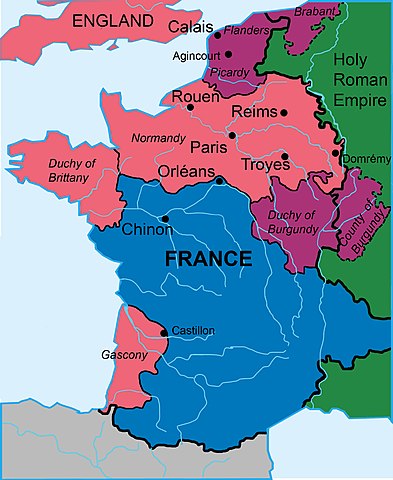
The Battle of Agincourt: A Turning Point
The Battle of Agincourt in 1415 was a pivotal moment in the Hundred Years’ War between England and France. While Brittany wasn’t directly involved in the battle, its aftermath would have profound implications for the duchy’s future.
Brittany’s Unique Position
Brittany, a semi-independent duchy on the western coast of France, found itself in a precarious position. Historically, it had maintained a delicate balance between its powerful neighbors, England and France.
Duke John V: A Strategic Player
In the wake of Agincourt, Brittany was ruled by Duke John V, a shrewd politician who understood the importance of maintaining Breton independence in the face of growing French and English power.
The Duke’s Dilemma
John V faced a difficult choice: align with the victorious English or maintain loyalty to the weakened French crown. His decisions in this period would shape Brittany’s fate for generations to come.
Brittany’s Shifting Alliances
In the years following Agincourt, Brittany’s alliances fluctuated. John V initially leaned towards the English, seeing them as a counterbalance to French power.
The Treaty of Troyes
In 1420, the Treaty of Troyes seemingly settled the conflict, with Henry V of England named as heir to the French throne. John V, ever the pragmatist, swiftly pledged allegiance to this new order.
The Unexpected Twist: Joan of Arc
The emergence of Joan of Arc in 1429 dramatically altered the political landscape. Her victories reinvigorated the French cause, forcing John V to reassess his position.
Brittany’s Subtle Shift
As Joan’s successes mounted, John V began to distance himself from the English alliance, gradually aligning more closely with the resurgent French monarchy.
The Praguerie Rebellion
In 1440, Brittany became embroiled in the Praguerie, a rebellion against the French king Charles VII. This event highlighted the complex web of loyalties and rivalries in post-Agincourt France.
John V’s Clever Maneuvering
Despite initially supporting the rebellion, John V managed to extricate himself from the conflict without serious consequences, demonstrating his political acumen.
The Rise of Breton Military Might
In the power vacuum left by Agincourt, Brittany began to assert itself militarily. The duchy developed a formidable army and navy, becoming a force to be reckoned with in Western Europe.
The Breton Navy
Brittany’s strategic location on the Atlantic coast allowed it to develop a powerful navy, which played a crucial role in protecting its interests and engaging in lucrative privateering activities.
Economic Prosperity in the Shadow of War
Paradoxically, the ongoing conflict between England and France created opportunities for Breton merchants and traders. Brittany’s ports became vital hubs in the Atlantic trade network. The duchy’s strategic position allowed it to profit from both sides of the conflict, engaging in trade with England and France, as well as with more distant partners.
The Rise of Nantes
The city of Nantes, in particular, flourished during this period, becoming one of the wealthiest and most important ports in Western Europe. Its location on the Loire River, combined with its access to the Atlantic, made it an ideal center for maritime trade. Nantes became a key point for the export of Breton cloth, salt, and wine, and the import of exotic goods from as far away as the Mediterranean and North Africa.
The Salt Trade
One of the most lucrative industries for Brittany during this period was the salt trade. The salt marshes of Guérande and the Bay of Bourgneuf produced high-quality salt that was in great demand across Europe. Salt was essential for food preservation, and Breton salt was particularly prized for its purity. The control of this vital commodity significantly boosted Brittany’s economic power and diplomatic leverage.
Textile Industry
Another key sector of the Breton economy was the textile industry. The duchy became renowned for its high-quality linen and hemp cloth. The canvases produced in Brittany were particularly sought after for shipbuilding, as they were used to make sails. This industry not only provided a valuable export but also supported Brittany’s growing naval power.
Financial Innovations
The economic boom in Brittany led to financial innovations. The duchy saw the development of sophisticated banking systems to handle the increased flow of money and credit. Breton merchants began to use bills of exchange more frequently, facilitating long-distance trade and reducing the risks associated with transporting large amounts of coin.
Agricultural Advancements
While maritime trade was booming, Brittany also saw advancements in agriculture. The introduction of new crops and farming techniques helped to increase agricultural productivity. This not only supported the growing urban populations in cities like Nantes and Rennes but also provided surplus for export.
Economic Challenges and Adaptations
Despite the overall prosperity, Brittany faced economic challenges in the post-Agincourt period. The ongoing war between England and France occasionally disrupted trade routes and led to periods of instability. However, Breton merchants showed remarkable adaptability in the face of these challenges.
Privateering and Naval Power
When traditional trade was disrupted, many Breton ship owners turned to privateering. With the tacit support of the Duke, Breton privateers preyed on enemy shipping, particularly targeting English merchants. This not only provided an alternative source of income but also strengthened Brittany’s naval capabilities, as experienced privateers could be called upon to serve in the Duke’s navy during times of war.
Economic Diplomacy
The Dukes of Brittany, particularly John V and his successors, engaged in a form of economic diplomacy. They negotiated trade agreements and truces that protected Breton commercial interests, even when political relations were strained. This pragmatic approach allowed Brittany to maintain its economic ties with both England and France, despite the ongoing conflict between these two powers.
Investment in Infrastructure
The economic prosperity of this period allowed for significant investments in infrastructure. New harbors were constructed, and existing ones were improved to handle the increased maritime traffic. Roads were also upgraded to facilitate inland trade. These infrastructure investments not only supported immediate economic growth but also laid the foundation for Brittany’s continued prosperity in the following decades.
The Rise of Nantes
The city of Nantes, in particular, flourished during this period, becoming one of the wealthiest and most important ports in Western Europe.
Cultural Flourishing
Despite the political turbulence, or perhaps because of it, Brittany experienced a cultural renaissance in the decades following Agincourt. The Breton language and distinct cultural identity were reinforced during this period.
The Golden Age of Breton Architecture
This era saw the construction of many of Brittany’s most iconic buildings, including the Château des Ducs de Bretagne in Nantes, a symbol of Breton power and autonomy.
The Seeds of Future Conflict
While Brittany prospered in the short term, the very successes that strengthened the duchy also made it an increasingly attractive target for the French crown.
The Looming Threat
As France gradually recovered from Agincourt and the Hundred Years’ War, it began to look westward, seeing Brittany’s autonomy as a challenge to centralized French authority.
The Legacy of Post-Agincourt Brittany
The period following Agincourt was, in many ways, a golden age for Brittany. The duchy’s ability to navigate the complex political landscape allowed it to thrive when many other regions were suffering.
The Price of Independence
However, this independence came at a cost. The policies pursued by John V and his successors, while successful in the short term, ultimately set Brittany on a collision course with the French crown.
Brittany’s Eventual Fate
In a final twist of historical irony, the very success of Brittany in maintaining its independence after Agincourt would lead to its eventual downfall. In 1491, Brittany was permanently united with France through the marriage of Anne of Brittany to Charles VIII of France.
A Lasting Impact
Despite losing its independence, the legacy of post-Agincourt Brittany lived on. The unique Breton culture, language, and identity that were strengthened during this period continue to play a significant role in the region to this day.