The Spark of Hysteria
In 1692, the small Puritan community of Salem Village, Massachusetts, became the epicenter of one of the most infamous witch hunts in history. What began as a series of strange afflictions affecting young girls spiraled into a full-blown crisis that would leave an indelible mark on American history.
The Afflicted Girls
The trouble began when Abigail Williams, 11, and Elizabeth Parris, 9, the daughter and niece of Reverend Samuel Parris, started experiencing unexplainable fits. They screamed, threw things, uttered peculiar sounds, and contorted themselves into strange positions. Soon, other young women in the village began exhibiting similar symptoms.
Accusations and Arrests
As fear gripped the community, fingers were pointed at supposed perpetrators of witchcraft. The first three women accused were Tituba, the Parris family’s slave, Sarah Good, a homeless beggar, and Sarah Osborne, a poor elderly woman.
The Unlikely Accused
What started with accusations against societal outcasts soon spiraled out of control. Respectable community members, including wealthy merchants and even the former Salem Village minister’s wife, found themselves facing charges of witchcraft.
The Role of Spectral Evidence
One of the most controversial aspects of the trials was the admission of “spectral evidence” – testimony that the accused witch’s spirit or spectral shape appeared to the witness in a dream or vision.
Legal Precedent Overturned
The use of spectral evidence was a departure from usual legal practices. It allowed accusers to claim that someone’s spirit had afflicted them, even if the accused person was physically elsewhere at the time of the alleged crime.
The Trials Begin
The Court of Oyer and Terminer, established specifically to hear the witchcraft cases, began its proceedings in June 1692. The court was presided over by Chief Justice William Stoughton, who proved to be a zealous believer in the witch hunt.
Unusual Methods of Proof
Besides spectral evidence, other bizarre methods were used to “prove” witchcraft. These included the “touch test,” where it was believed that a witch’s touch would cease the afflicted person’s fits, and searching for “witch’s marks” – supposedly supernatural markings on the body.
The Execution of Giles Corey
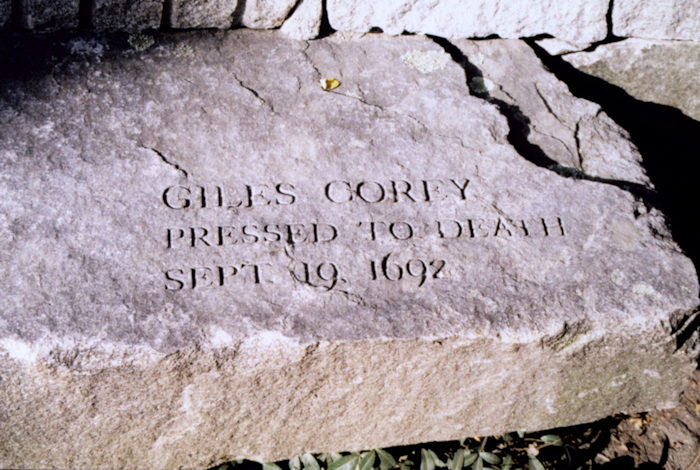
One of the most gruesome episodes of the trials was the execution of Giles Corey. When Corey refused to enter a plea, he was subjected to “peine forte et dure” – being pressed to death with heavy stones. Corey’s last words, “More weight,” became a symbol of defiance against the trials.
A Twist of Fate
Ironically, Corey’s refusal to plea may have been a strategic move. By not entering a plea, he avoided conviction and thus prevented his estate from being seized by the government, ensuring his children would inherit his property.
The Climax of the Hysteria
By September 1692, the hysteria reached its peak. Twenty people had been executed, and more than 100 others were in jail awaiting trial. Among those executed was Rebecca Nurse, a 71-year-old woman of impeccable reputation, whose conviction shocked many and began to turn public opinion against the trials.
The Domino Effect
As accusations spread, no one was safe. Even some of the accusers, including Mary Warren, found themselves accused when they began to express doubts about the proceedings.
The Unraveling of the Witch Hunt
As more prominent citizens were accused, including the governor’s wife, skepticism about the trials grew. In October 1692, Governor William Phips dissolved the Court of Oyer and Terminer and prohibited further arrests.
The Last Gasps of the Trials
Although the worst was over, the legal proceedings dragged on into 1693. The last trials were held in January 1693, but this time, the majority of the accused were acquitted. In May 1693, Governor Phips released all remaining accused and convicted witches from prison.
Aftermath and Reconciliation
In the years following the trials, many of the key figures involved expressed remorse for their actions. Judge Samuel Sewall made a public apology, and Ann Putnam Jr., one of the primary accusers, publicly apologized in 1706.
Restitution and Remembrance
The Massachusetts legislature passed bills restoring the good names of the accused and providing compensation to their heirs. However, it wasn’t until 1957 that the state of Massachusetts formally apologized for the events of 1692.
Modern Interpretations and Theories
Over the centuries, numerous theories have been proposed to explain the events in Salem. These range from ergot poisoning (a fungus that can cause hallucinations) to socio-economic tensions and PTSD from Indian attacks.
A Cautionary Tale
Today, the Salem Witch Trials serve as a cautionary tale about the dangers of mass hysteria, the importance of due process, and the potential for injustice within the legal system. The trials continue to fascinate and horrify, reminding us of the fragility of justice and the power of fear.
Legacy in Popular Culture
The Salem Witch Trials have left an indelible mark on American culture, inspiring countless books, films, and plays. Arthur Miller’s 1953 play “The Crucible” famously used the trials as an allegory for McCarthyism, demonstrating the enduring relevance of this historical event.
Salem Today
Modern-day Salem has embraced its infamous history, becoming a popular tourist destination, especially around Halloween. The city now features numerous witch-themed attractions, as well as more serious historical sites and memorials dedicated to the victims of the trials.